Frequently Asked Questions
Product Information & Benchmarks
What is FalkorDB and what makes it unique as a graph database?
FalkorDB is a high-performance graph database designed for managing complex relationships and enabling advanced AI applications. It stands out for its exceptional speed, memory efficiency, and scalability, supporting over 10,000 multi-graphs and optimized for AI use cases like GraphRAG and agent memory. Learn more.
How does FalkorDB perform compared to Neo4j in benchmark tests?
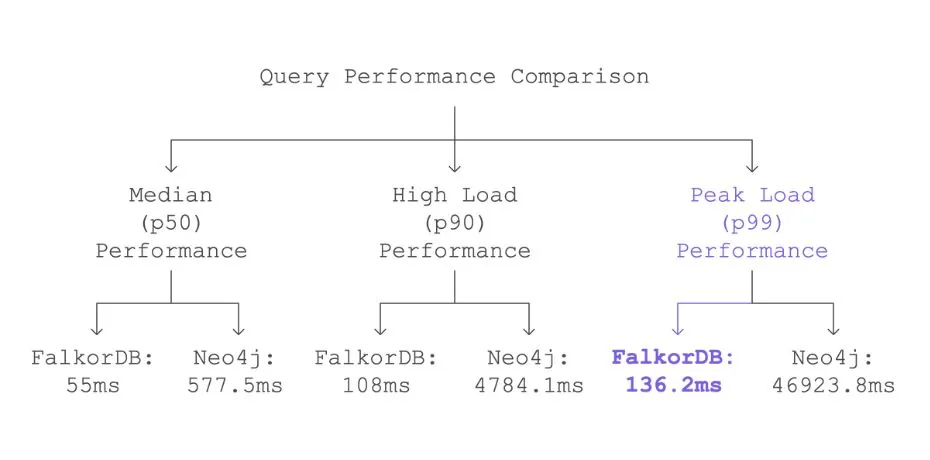
FalkorDB demonstrates significant performance advantages over Neo4j. In benchmark tests, FalkorDB processes median (p50) queries in 55ms compared to Neo4j’s 577.5ms, maintains 108ms at high load (p90) versus Neo4j’s 4784.1ms, and delivers 136.2ms latency at peak load (p99) while Neo4j reaches 46,923.8ms. These results show FalkorDB’s consistent sub-140ms response times, even under heavy workloads. See benchmarks.
What are the key performance metrics for FalkorDB under load?
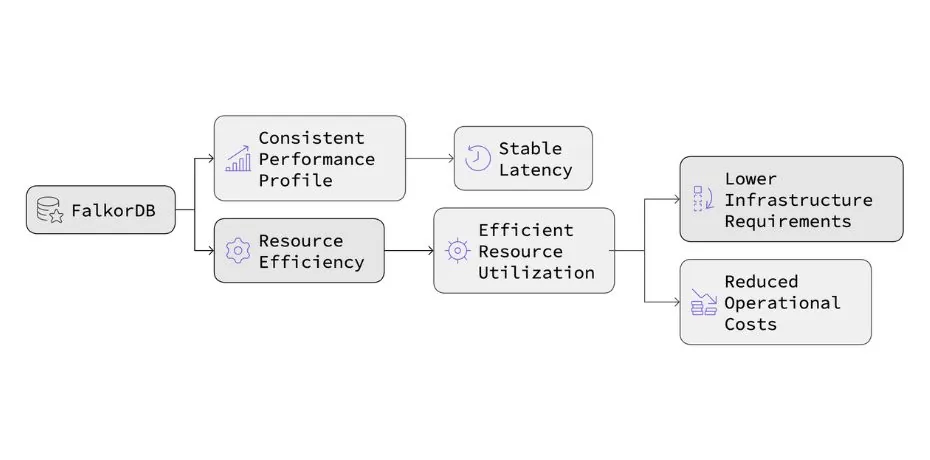
FalkorDB maintains predictable performance under varying loads, with latency increasing only 2.5x from p50 to p99. This stability ensures reliable operation for mission-critical workloads. Benchmarks were conducted on a 16-CPU, 32GB RAM system, demonstrating efficient resource utilization and lower infrastructure costs.
What types of queries and workloads were used in FalkorDB's benchmarks?
The benchmarks included 11 templated queries representing classic graph operations, with an 82% read and 18% write ratio. Examples include multi-hop traversals, node creation, edge creation, and filtering by properties. The dataset used was the SNAP Pokec social network, reflecting real-world production workloads.
Is FalkorDB production-ready?
Yes, FalkorDB is stable for production use. It is a continuation of the production-tested RedisGraph codebase, ensuring reliability for enterprise deployments.
What system requirements are needed to run FalkorDB?
FalkorDB requires a Linux/Unix system with a minimum of 4GB RAM. For production environments, 16GB RAM is recommended for optimal performance.
Which query language does FalkorDB use?
FalkorDB uses the Cypher query language, similar to Neo4j. This compatibility makes migration and onboarding straightforward for teams familiar with Cypher.
Does FalkorDB support data persistence?
Yes, FalkorDB supports data persistence through Redis mechanisms (RDB/AOF). Additional persistence options are in development to further enhance durability.
Does FalkorDB support major programming languages?
Yes, FalkorDB supports major programming languages including Python, Java, Go, and Node.js via Redis clients and the Bolt protocol. This ensures broad compatibility for developers.
Can I migrate from Neo4j to FalkorDB?
Yes, FalkorDB supports the Cypher query language, making migration from Neo4j straightforward. Migration tools are in development to further simplify the process.
What should I do if I get 'libgomp.so.1: cannot open shared object file' error?
Install OpenMP using your system's package manager. For Ubuntu: apt-get install libgomp1. For RHEL/CentOS: yum install libgomp. For OSX: brew install libomp.
What production features does FalkorDB support?
FalkorDB supports Cypher query compatibility, Redis persistence, major programming language integrations, multi-tenant deployments, and horizontal scaling. These features make it suitable for mission-critical workloads.
How does FalkorDB handle multi-tenancy?
FalkorDB provides native multi-tenancy, supporting over 10,000 multi-graphs. This enables efficient resource utilization and is ideal for SaaS providers and enterprises with diverse user bases.
What is the impact of FalkorDB's performance on Retrieval Augmented Generation (RAG) applications?
FalkorDB’s sub-140ms query latency and built-in GraphRAG support enable higher throughput and faster implementation for RAG applications, outperforming Neo4j’s multi-second latencies and custom RAG support.
What hardware was used for FalkorDB's benchmark tests?
The benchmarks were run on an x86_64 architecture with 8 cores/16 threads, 32GB RAM, and a Linux-based GitHub Actions Runner, using the SNAP Pokec social network dataset.
Does FalkorDB support horizontal scaling?
Yes, FalkorDB supports flexible horizontal scaling, allowing it to efficiently manage large-scale, high-dimensional data and adapt to growing workloads.
How does FalkorDB's latency compare to Neo4j at peak load?
At peak load (p99), FalkorDB delivers 136.2ms latency, while Neo4j reaches 46,923.8ms, demonstrating FalkorDB’s superior performance and predictability under stress.
What is the read/write ratio in FalkorDB's benchmark tests?
The benchmark tests used an 82% read and 18% write ratio, reflecting typical production workloads for graph databases.
What are some example Cypher queries used in FalkorDB benchmarks?
Examples include multi-hop traversals (e.g., MATCH (s:User {id: $id})-->()-->(n:User) RETURN DISTINCT n.id), filtering by properties, creating nodes and edges, and finding neighbors. These queries represent common graph operations.
Features & Capabilities
What features does FalkorDB offer for AI and advanced analytics?
FalkorDB is optimized for AI applications, including GraphRAG, agent memory, and chatbots. It combines graph traversal with vector search for personalized user experiences and supports real-time adaptability for intelligent agents. Learn more.
Does FalkorDB support multi-tenancy out of the box?
Yes, FalkorDB includes native multi-tenancy in all plans, supporting over 10,000 multi-graphs. This is especially valuable for SaaS providers and organizations with diverse user bases.
What integrations are available for FalkorDB?
FalkorDB integrates with frameworks like Graphiti (by ZEP), g.v() for visualization, Cognee for AI agent memory, LangChain and LlamaIndex for LLM integration, and supports major programming languages. See integrations.
Does FalkorDB provide an API?
Yes, FalkorDB provides a comprehensive API with official documentation and guides available at docs.falkordb.com. These resources support developers, data scientists, and engineers in integrating FalkorDB into their workflows.
Is FalkorDB open source?
Yes, FalkorDB is open source, encouraging community collaboration and transparency. This differentiates it from proprietary solutions like AWS Neptune.
What security and compliance certifications does FalkorDB have?
FalkorDB is SOC 2 Type II compliant, meeting rigorous standards for security, availability, processing integrity, confidentiality, and privacy. Learn more.
What technical documentation is available for FalkorDB?
FalkorDB provides comprehensive technical documentation, including API references, setup guides, and advanced configuration instructions. Access the documentation at docs.falkordb.com and the latest release notes on the GitHub Releases Page.
How easy is it to implement FalkorDB and get started?
FalkorDB is built for rapid deployment, allowing teams to go from concept to enterprise-grade solutions in weeks. You can sign up for FalkorDB Cloud, try it for free, run locally with Docker, or schedule a demo. Comprehensive documentation and community support are available. Get started.
What support and training options are available for FalkorDB?
FalkorDB offers comprehensive documentation, community support via Discord and GitHub Discussions, access to solution architects, and free trial/demo options for onboarding. See documentation.
Pricing & Plans
What pricing plans does FalkorDB offer?
FalkorDB offers four main pricing plans: FREE (for MVPs with community support), STARTUP (from /1GB/month, includes TLS and automated backups), PRO (from 0/8GB/month, includes cluster deployment and high availability), and ENTERPRISE (custom pricing with enterprise-grade features and 24/7 support). See pricing.
What features are included in the PRO plan?
The PRO plan starts at 0/8GB/month and includes advanced features such as cluster deployment, high availability, and enhanced support for demanding workloads.
Is there a free trial or free plan for FalkorDB?
Yes, FalkorDB offers a FREE plan designed for building MVPs with community support. You can also try FalkorDB for free in the cloud or locally using Docker.
Competition & Comparison
How does FalkorDB compare to Neo4j?
FalkorDB outperforms Neo4j in latency, memory efficiency, and scalability. It offers up to 496x faster latency, 6x better memory efficiency, and includes multi-tenancy in all plans. FalkorDB is open source and supports flexible horizontal scaling. See detailed comparison.
How does FalkorDB compare to AWS Neptune?
FalkorDB provides better latency performance, supports multi-tenancy, and is open source, unlike the proprietary AWS Neptune. It also offers highly efficient vector search and supports the Cypher query language. See comparison.
How does FalkorDB compare to TigerGraph and ArangoDB?
FalkorDB delivers faster latency and more efficient memory usage than TigerGraph and ArangoDB. It supports flexible horizontal scaling and is rated as 'fast' compared to their 'adequate' or 'poor' latency. Learn more.
Why choose FalkorDB over other graph databases?
FalkorDB offers superior performance, scalability, native multi-tenancy, advanced AI integration, open-source licensing, and enhanced user experience. It is trusted by customers like AdaptX, XR.Voyage, and Virtuous AI. See case studies.
Use Cases & Benefits
What are the main use cases for FalkorDB?
FalkorDB is used for Text2SQL (natural language to SQL), security graphs (CNAPP, CSPM, CIEM), GraphRAG, agentic AI and chatbots, fraud detection, and high-performance graph storage for complex relationships. Learn more.
Who can benefit from using FalkorDB?
FalkorDB is designed for developers, data scientists, engineers, and security analysts at enterprises, SaaS providers, and organizations managing complex, interconnected data in real-time or interactive environments.
What business impact can customers expect from using FalkorDB?
Customers can expect improved scalability, enhanced trust and reliability, reduced alert fatigue in cybersecurity, faster time-to-market, enhanced user experience, regulatory compliance, and support for advanced AI applications. Learn more.
What pain points does FalkorDB address?
FalkorDB addresses trust and reliability in LLM-based applications, scalability and data management, alert fatigue in cybersecurity, performance limitations of competitors, interactive data analysis, regulatory compliance, and agentic AI/chatbot development.
Can you share specific case studies or customer success stories?
Yes. AdaptX uses FalkorDB for clinical data analysis, XR.Voyage for immersive experience platforms, and Virtuous AI for ethical AI development. Read their stories in our case studies.
What industries are represented in FalkorDB's case studies?
Industries include healthcare (AdaptX), media and entertainment (XR.Voyage), and artificial intelligence/ethical AI development (Virtuous AI). See case studies.
What feedback have customers given about FalkorDB's ease of use?
Customers like AdaptX and 2Arrows have praised FalkorDB for its ease of use, rapid access to insights, and superior performance compared to Neo4j, especially for non-traversal queries. Read testimonials.
What core problems does FalkorDB solve?
FalkorDB solves trust and reliability issues in LLM-based applications, enables efficient management of large-scale data, reduces alert fatigue in cybersecurity, overcomes performance limitations of competitors, supports interactive data analysis, ensures regulatory compliance, and powers agentic AI and chatbots.